



Insertion
Mutations develop from both insertion and loss of segments of DNA. Deletions or insertions of short regions can occur by strand slippage, and deletions or insertions of longer regions can occur via homologous recombination.
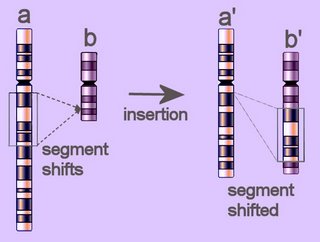
Diagram of insertion of a segment of chromosome a into chromosome b, resulting in shortened chromosome a' and lengthened chromosome b' (click to enlarge image).
If the number of inserted bases is not a multiple of 3, insertion will cause frameshift, with serious consequences. A number of diseases are caused by insertions without frameshift - Huntington's chorea, Myotonic Dystrophy, Fragile X site A, Fragile X site E, Fragile X site F, Kennedy disease, SCA1, DRPLA.
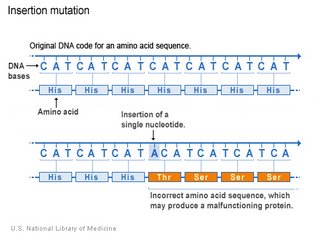
Proteins gradually evolve by the accumulation of mutations.
Mobile elements called insertion sequences exist in nature. These sequences encode only the information necessary for their insertion into DNA. Depending upon the particular insertion sequence, they can insert at specific regions or at random.
Tables Mechanisms of Biological Evolution Gene Regulation in E.coli :
It has been known since the beginning of the twentieth century that unstable or variable gene loci occur in plants. Breakage-fusion (reunion)-bridges are formed during anaphase whenever two chromosomes fuse at their ends, generating a fusion product with two centromers. If these two fused chromosomes are subsequently carried to different poles than the regular chromosomes, a chromosomal fraction results. During the subsequent S-phase, the chromatid with a fused-fraction at its terminus will replicate, leading again to a fusion of the homologous chromatids. Consequently a chromosome comprising one chromatid with two centromeres will occur in the subsequent mitosis, rather than a chromosome from two chromatids and one centromere. Consequently, a second fraction occurs during anaphase when the second round of the cycle starts.
B. McClintock recognized (between ‘47 and ‘51) that the chromosomal fraction is restricted to certain sections of the chromosome, which she termed Ds (dissociation). The Ds segment is a mutator gene, which behaves like a pseudoallele that can be located at different gene loci. This mutator gene can insert itself into other genes, rendering them inactive. Thus, it is a control element that changes its location within the chromosome, causing mutations wherever it inserts. Such mutator genes are also called "jumping genes".
A further set of elements, the Ac (activation) elements, support the chromosomal fraction or a translocation of a Ds element. An Ac element can be regarded as a multiple allele, and it may occur different sites in all chromosomes. A number of gene loci are known to be influenced by the Ds-Ac-system or other control elements. Detection of the spm-system (suppressor-mutator) and the elucidation of its function established that the control elements not only act as switches (a yes/ no decision) but that they also modulate the degree of gene expression.
Insertion elements and transposons were first detected in bacterial DNA during the late sixties. This discovery explained the connection between transposons and the chromosome fraction control elements.
Table Mechanisms of Biological Evolution : Gene Regulation in E.coli :
External : Transposons part 1, transposons part 2 : Barbara McClintock and mobile genetic elements :

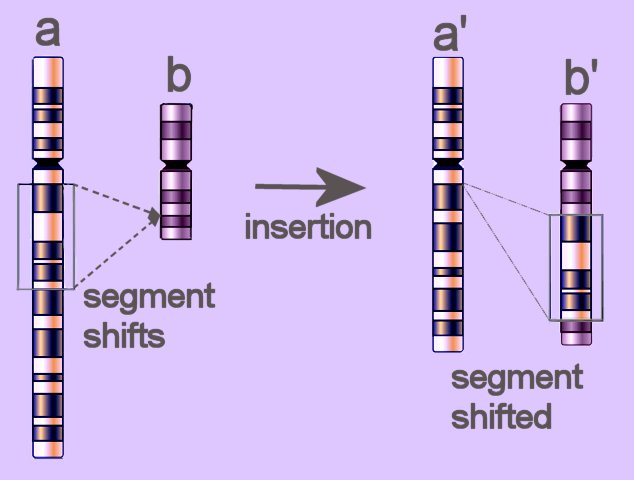
Diagram of insertion of a segment of chromosome a into chromosome b, resulting in shortened chromosome a' and lengthened chromosome b' (click to enlarge image).
If the number of inserted bases is not a multiple of 3, insertion will cause frameshift, with serious consequences. A number of diseases are caused by insertions without frameshift - Huntington's chorea, Myotonic Dystrophy, Fragile X site A, Fragile X site E, Fragile X site F, Kennedy disease, SCA1, DRPLA.
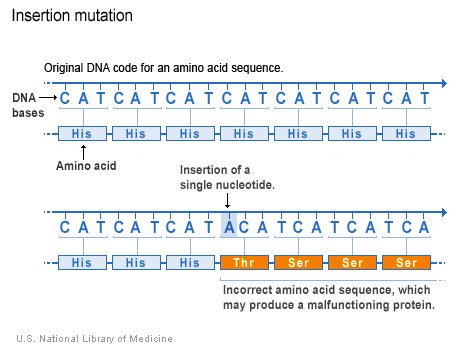
Proteins gradually evolve by the accumulation of mutations.
Mobile elements called insertion sequences exist in nature. These sequences encode only the information necessary for their insertion into DNA. Depending upon the particular insertion sequence, they can insert at specific regions or at random.
Tables Mechanisms of Biological Evolution Gene Regulation in E.coli :
It has been known since the beginning of the twentieth century that unstable or variable gene loci occur in plants. Breakage-fusion (reunion)-bridges are formed during anaphase whenever two chromosomes fuse at their ends, generating a fusion product with two centromers. If these two fused chromosomes are subsequently carried to different poles than the regular chromosomes, a chromosomal fraction results. During the subsequent S-phase, the chromatid with a fused-fraction at its terminus will replicate, leading again to a fusion of the homologous chromatids. Consequently a chromosome comprising one chromatid with two centromeres will occur in the subsequent mitosis, rather than a chromosome from two chromatids and one centromere. Consequently, a second fraction occurs during anaphase when the second round of the cycle starts.
B. McClintock recognized (between ‘47 and ‘51) that the chromosomal fraction is restricted to certain sections of the chromosome, which she termed Ds (dissociation). The Ds segment is a mutator gene, which behaves like a pseudoallele that can be located at different gene loci. This mutator gene can insert itself into other genes, rendering them inactive. Thus, it is a control element that changes its location within the chromosome, causing mutations wherever it inserts. Such mutator genes are also called "jumping genes".
A further set of elements, the Ac (activation) elements, support the chromosomal fraction or a translocation of a Ds element. An Ac element can be regarded as a multiple allele, and it may occur different sites in all chromosomes. A number of gene loci are known to be influenced by the Ds-Ac-system or other control elements. Detection of the spm-system (suppressor-mutator) and the elucidation of its function established that the control elements not only act as switches (a yes/ no decision) but that they also modulate the degree of gene expression.
Insertion elements and transposons were first detected in bacterial DNA during the late sixties. This discovery explained the connection between transposons and the chromosome fraction control elements.
Table Mechanisms of Biological Evolution : Gene Regulation in E.coli :
External : Transposons part 1, transposons part 2 : Barbara McClintock and mobile genetic elements :
Labels: Barbara McClintock, deletion, insertion, MGE, mobile genetic elements, mutation, transposons
| 2 Guide-Glossary